Resolve implementation requirements
Work through state-federal modifications and the requirements needed to put the award into operation.
PROGRAM DESIGN / Tennessee Department of Education
An application, budget tools, and review process that put a statewide grant competition into operation.
SEE THE WORK
What applicants and reviewers actually worked from.
Respond to each prompt in the space provided. Reviewers score each response independently using the published rubric.
Describe the school's instructional model and explain how it is designed to serve the students the school expects to enroll.
Response limit: 750 words
Explain how subgrant funds will support the school's opening and early implementation, and how those activities align with the budget worksheets.
Response limit: 500 words · Cross-reference Budget Worksheets 1 to 3
Recreation of an application page. Structure, prompt count, and scoring format mirror the real package; prompt wording here is a representative paraphrase.
| A | B | C | D | E | F | |
|---|---|---|---|---|---|---|
| 1 | Line | Allowable cost category | Planning year | Implementation Y1 | Implementation Y2 | Total |
| 2 | 1.1 | Planning-year personnel | $90,000 | $0 | $0 | $90,000 |
| 3 | 1.2 | Professional development | $20,000 | $45,000 | $35,000 | $100,000 |
| 4 | 1.3 | Curriculum and instructional materials | $10,000 | $120,000 | $80,000 | $210,000 |
| 5 | 1.4 | Technology and equipment | $0 | $110,000 | $70,000 | $180,000 |
| 6 | 1.5 | Community outreach and enrollment | $25,000 | $20,000 | $15,000 | $60,000 |
| 7 | 1.6 | Furniture (non-capital) | $5,000 | $55,000 | $50,000 | $110,000 |
| 8 | Total request | $150,000 | $350,000 | $250,000 | $750,000 |
Recreation of the budget worksheet with a fictional applicant's figures. The built-in cap check reflects the real design: subgrants of up to $750K, with totals validated before submission.
| Rating | Points | Evidence in the response |
|---|---|---|
| Exceeds | 13 to 15 | Model is clearly tied to the anticipated student population, first-year delivery is specific, and success measures are defined. |
| Meets | 9 to 12 | Model and population are connected; first-year delivery is described but some measures are general. |
| Partially meets | 4 to 8 | Model is described but the connection to students or implementation is unclear. |
| Does not meet | 0 to 3 | Response is missing, generic, or does not address the prompt. |
Score the response as written. Do not credit information found only in other sections unless the prompt directs a cross-reference.
Recreation of a rubric page in the format used for external reviewers. Descriptors are representative, not the published language.
THE STARTING POINT
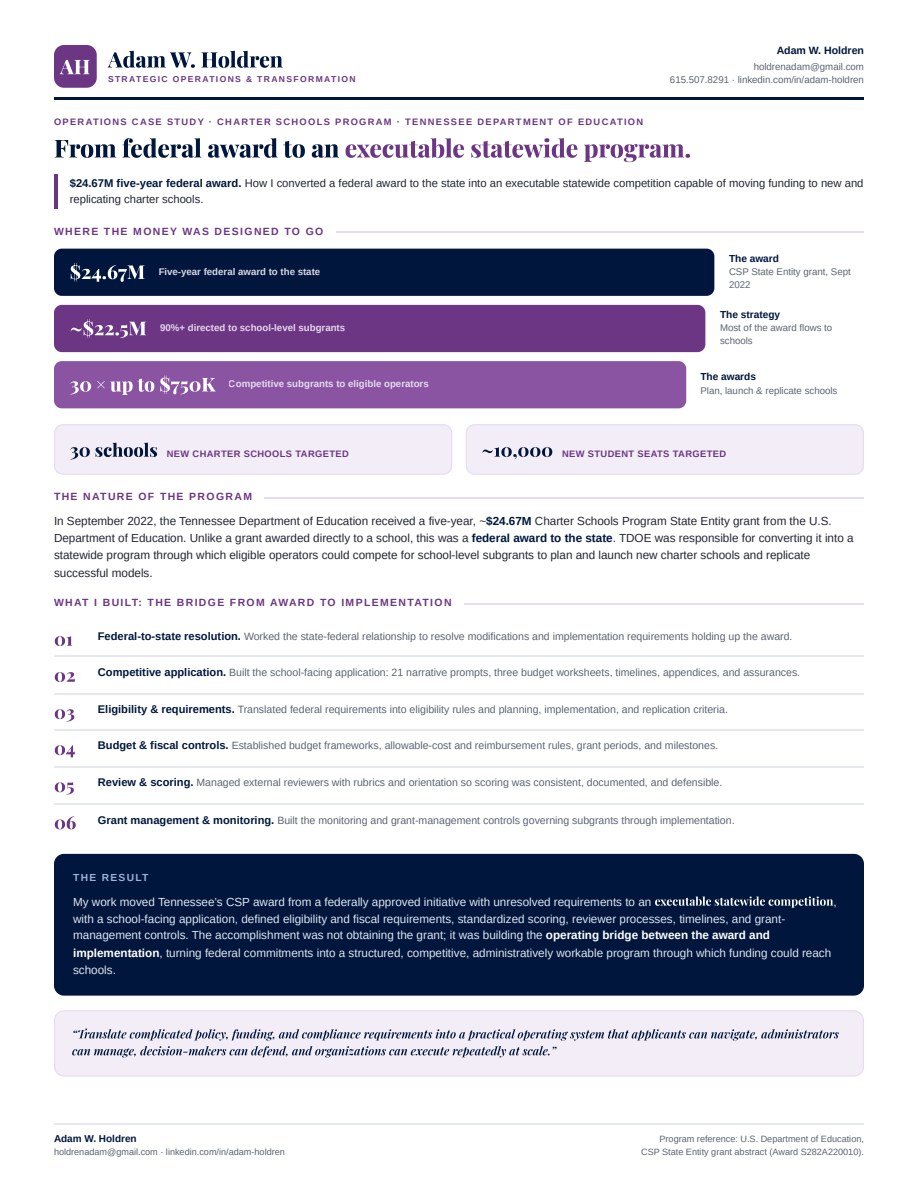
A federal award to the state still needed an operating structure before schools could compete for subgrants. Unresolved requirements, eligibility, application design, review processes, and fiscal controls all had to connect.
THE WORK
Work through state-federal modifications and the requirements needed to put the award into operation.
Develop 21 narrative prompts, three budget worksheets, timelines, appendices, and assurances.
Coordinate external reviewers around rubrics, orientation, and documented scoring expectations.
Define eligibility, allowable costs, reimbursement rules, milestones, and grant-management controls.
BEFORE AI
I didn’t use AI for this work. The leverage came from structure: standardized templates, formula-driven budget worksheets with built-in checks, and a rubric every reviewer applied the same way.
THE RESULT
The $24.67M federal award went to the state; my role was building the program that put it to work. School and student-seat goals were targets for the life of the award, not completed outcomes.
PROJECT DOCUMENT
A one-page overview of the context, work, and result.
Read the case study PDF ↗